A rchive Date
[ 29-06-2005 ]
Category
[ International Relations ]
sub-Categoy
[ U.S ]
|
[http://www.techcentralstation.com/062905E.html
The Stag Party
By Jerry Bowyer
Published 06
It's beyond me how anybody could look at this economy and think of stagflation. After all, President Bush mostly takes his cues from Ronald Reagan (who ended that problem), not from Jimmy Carter (who presided over it). Nevertheless, New York Times columnist Paul Krugman manages to free associate himself and his readers right into just such a comparison. That the Times columnist sounds the inflation alarm so shortly after having warned his readers of the opposite danger, deflation, reinforces an impression that he and like-minded colleagues spend their evenings skimming through the glossaries of economics textbooks putting checkmarks next to each and every economic malady, even the ones that contradict one another. Deflation, check; Inflation, check. Stagnation, check; overheating, check. Strong dollar, check; weak dollar, check.
Krugman simply ignores the origins and history of this malady. Stagflation was such a mystery to Keynesians like Krugman because they believed that it was proper to use money creation to stimulate the economy. The 1970s were a time of high taxes and heavy regulation which slowed economic growth; the government tried to counter such stagnation by printing more dollars. After the Bretton Woods Agreements had collapsed, the gold standard was scrapped in 1971 so the major impediment to excessive money creation was effectively removed. Fiat money flowed into the economy, pumped in by pliant Fed chairmen. Contrary to Keynesian theory, we Americans did not get economic growth and low unemployment; we got what Keynesianism predicts is impossible - stagflation.
What's ironic about this is that the reasoning that led to the policy disaster of the 1970s is exactly the same reasoning that Krugman used in a recent piece:
"In the 1970's soaring prices of oil and other commodities led to stagflation - a combination of high inflation and high unemployment, which left no good policy options. If the Fed cut interest rates to create jobs, it risked causing an inflationary spiral. ..."
In order to raise the level of alarm about our alleged bout of stagflation, Krugman points out that we won't be able to use the printing press to stimulate our way into growth this time. Of course the belief that you ever could use new money to stimulate growth is exactly the policy error that created stagflation in the first place.
If Keynesian economics created inflation, then it was Supply Side economics that ended it. Then Fed Chairman Paul Volcker cut the money supply, and Reagan cut the taxes. Monetary policy was properly distinguished again from fiscal policy. Money determines the level of inflation, and taxes help determine the level of growth. It worked; inflation plummeted and growth soared.
It might be interesting to take a look at what the young economist Paul Krugman was predicting at that time. In 1982, Krugman was on the staff of the Council of Economic Advisors. Columnists Bruce Bartlett and Donald Luskin have unearthed a memo that he and Larry Summers wrote that September. In the section entitled "The Inflation Time Bomb" they predicted "... that it is reasonable to expect a significant reacceleration of inflation in the near future". (Inflation During the 1983 Recovery, Sept. 9, 1982, Paul Krugman, Larry Summers). Of course as history records, the opposite occurred.
Regarding our alleged current stagflation, it's the "stag" part I question and not the "inflation." Supply siders have been issuing warnings against inflation for some time now, and we welcome The New York Times columnist to the party, even if he is somewhat late. What we don't buy are the shrill and unrelenting attempts to deny the strength of this economy despite all evidence to the contrary. In an attempt to downplay the fact that unemployment is approximately the same as during the Clinton years, Krugman relies on the old saw that people have given up looking for work. Actually, they haven't, as the attached chart shows that the labor force is growing, not shrinking.
/29/2005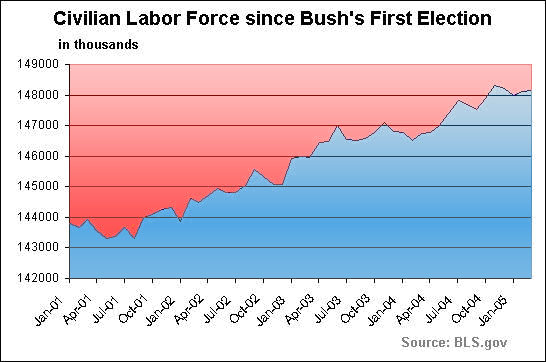
Admittedly, during the past three months the Civilian Labor Force is down a small 46,000, but since Bush's first election it's up 4.4 million and since his big tax cut in May 2003 it's up 1.7 million. It makes sense that when the economy booms, people flow back into the job market, not out of it.
To be honest, it's getting a little tough to keep up with the swirling series of economic boogeymen conjured by Krugman & Co. Today, it's stagflation. But in his latest book (The Great Unraveling, published in September, 2003), and in his columns, he's been raising the specter of deflationary "liquidity traps" and admonishing us to brush up on our "depression economics."
We have a better idea. Instead of us brushing up on our depression economics, perhaps it's time for Mr. Krugman and his colleagues at The New York Times to finally brush up on their supply-side economics. There will be fewer surprises for them and for their readers if they do.
© 2005 Tech Central Station
 World Fact Book (CIA] World Fact Book (CIA]
|