A rchive Date
[ 12-03-2005 ]
Category
[ Information Technologies ]
sub-Categoy
[ Mass Media ]
|
[Developing Trends In Digital and Broadband Communication
Or Why Do We Buy Stuff?
Technology, some argue, can solve some of the world’s most pressing problems, even bring humanity closer together.
Notlimah Hsineved 03/12/2005
People as consumers, it seems, get attached to products or companies. That is, they don't just simply buy products: they buy a concept of what the product can do for them. And so, quite often the brand name becomes the product – in addition to any practical use for a product itself.
OverView
There are several major factors that differentiate today’s global economies. For the purpose of this analysis, that includes easy access to Hi-Speed or Broadband content communication, the tools and the means by which those economies advance and the resulting market segmentation that takes place along the way. In the area of Broadband such segmentation has given rise to what some refer to as nano-niches. For example,
The Internet allows small numbers of like-minded and geographically disparate individuals to function as a nano-niche or definable demographic group of consumers available to other marketers (buyers, sellers and traders).
Plummeting costs of communication catalyse nano-niches where it becomes possible to buy, sell or trade quantities of low value products or those which may be of limited interest to a broader marketplace.
Further segmentation of the marketplace happen each time a new product is introduced and secures a foothold for the service or product.
Through the evolution, broad dispersion and acceptance of computing, Broadband Communication and ancillary technologies we see:
The convergence of the Internet and Cellphones makes it possible for small one-man businesses to be as easily accessible as larger businesses with secretaries and support staff.
Search Engines that have revolutionised searches on the Internet with features and functionalities that, in most cases, have replaced or supplanted the need for hard-copy directories (phone books) directory assistance employees or the posting of ads on local community bulletin-boards.
Auction Sites that create global markets where anyone can advertise and sell/trade their wares. Whereas they would previously have been consigned to the rubbish heap - they can now be bought, sold or traded online.
Hi-Tech Yard & Garage Sales are no longer confined to local communities. Numerous people now make a living buying, selling and trading online through services, such as eBay. Without the Internet the cost of these enterprises as business models would make them untenable or non-profitable.
E-tailers, such as ebuyer.com and Amazon.com , are examples of on-line shops. The lack of a sales force, premises and other inventory stocks necessary to a pre-Internet marketplace has driven down the costs of doing business. Business models such as these online e-tailers do not necessarily work for every product. That is, its strength rests in branded commodities where word-of-mouth recommendations drive sales or traffic.
Music and Film. Catalogue shopping has become easier as hard-to-find items can be access discovered through the combined use of online searches and advertising. Secondhand items and stock clearance items can traded at lower costs.
Desktop Video Publishing is now commonplace. The previous barriers to entry of expensive editing are being erased.
Software. The ease and speed of Hyper-communication make it possible for small numbers of people spread disparately over the world to join together working on large software projects.
Automobiles. Due, partly to overproduction and technological advances, automobiles are becoming relatively cheaper to produce and market; and so, automobile producers and dealers must now contend with longer car-replacement cycles. (1)
Similar examples of this trend is discernible within the Broadband technology industry and consumer markets as broadband content providers and distributors seek ways to capitalise on available or emerging technologies. It may be worth keeping in mind that the arrival of consumer VCR technology resulted in the restructuring of public theatres as the associated social act of 'going to the movies' trended away from public to private viewing experiences.
Trends Among Broadband Content, Delivery and Consumption
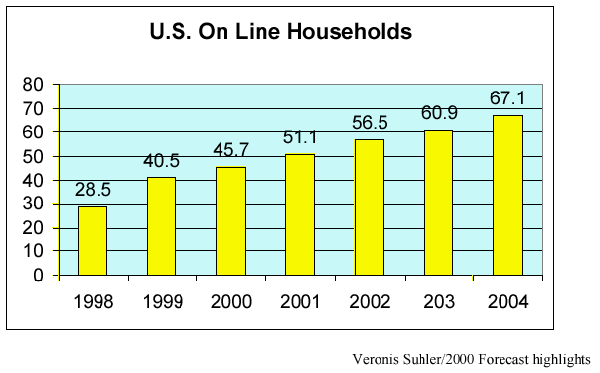 (2)
(2)
The Broadband Industry: Content and Service Providers
In a keynote address at the recent Seybold Seminars Boston Publishing 2000 conference, statistical data presented to show that commercial printing is virtually a no-growth industry; and that zero-growth implies an industry in decline.
Of the factors cited for this trend, one was termed Generational. That is, demographic surveys show that young people, as consumers, raised in front of computer screens, surf the Web, complete assignments digitally, carry cell phones, play video games and listen to MP3 music much more than their parents are likely to do. Some see this as likely leading to a decline in print as a primary communication medium. The effect that generational preferences is having on print consumption is mirrored in the music industry as well – going from 78 rpm records to 33 1/3, then to CDs and now MP3s – which have managed implement the conversions along the buying habits of each generation of consumers.
In addition, the education system has been weighing in with the evolving trends to the point that schools are now considering e-books as a way to keep text current and/or ‘ease the burden of students’ who carry around heavy backpacks. With the potential to have an e-book at the desk of every student, in time we will see an entire generation that will have little or no familiarity with print as a medium.
So, electronic and technological advances are clearly catalytic factors that spurred the rapid development of the Internet which has had a transformative effect on almost every aspect of society and national economies. And just as important, the internet and the WWW have transformed many previous and necessary forms of print - reference manuals or industry documentation into searchable electronic document databases as online documentation has been enriched with features like hyperlinks that increase the efficiency or speed of research and retrieval by several factors. (3)
A UCLA study that monitored the impact of the Internet on society and social interaction found that nearly two-thirds of all Americans venture online. However, the majority scoff at the idea that the internet creates social isolation. More than 75 percent said they do not feel ignored by relatives and friends as a result of chat-room activity. In fact, the majority of Internet users said e-mail, Web sites and chat rooms have a ‘modestly positive impact’' on their abilities to make new friends and communicate more with family.
The UCLA researchers caution, however, that the internet as an increasingly popular communication tool will have profound long-term effects that have not yet been detected. The internet, the say, changes our values, communication patterns, consumer behavior or even how neighbors recognise each other. The study they say - which focused on the opinions and online habits of the respondents that were both users and nonusers of the internet–mirror the ethnic, economic and geographic demographics. One finding was that more than 70 percent said children's grades are neither helped nor hurt by internet activity. But two-thirds said they now buy less from traditional retailers, preferring to do so online. (4)
Broadband: Content, Delivery Systems and Convergence
Demand by millions of consumers for broadband content in the area of multimedia audio or video makes it easier to measure the level of public acceptance and consumption of digital media products that’s encoded to take advantage of the high transmission speeds of broadband connections. Together with current computer software, such as Windows Media Player, it’s possible to watch full-screen TV-like videos on either computer monitors or traditional television set.
The conclusion of key speakers at the 5th annual 20/20: Vision on Print Conference in Berlin was that the future's killer application will be broadband based. Most foresee that as consumer demand for broadband content increases there’ll be less satisfaction with current performance, quality, available content and costs. This, in effect, will push service providers into looking for innovative ways of increasing bandwidth to meet content demand. Already, copper wire transmission technology is being phased out in favor of fibre, wireless and satellite networks that can delivery higher capacities at lower operating costs.
It’s important to keep this in minds. In a study compiled using data from Keynote, an Internet performance measurement company taken between October 1998 and June 1999, in spite of overall improvements in performance and medium, the ability of broadband transmitters to sustain performance-based applications is already being stressed.
Recent studies have found that, despite overall improvements in capacities, broadband may not be able to meet or sustain performance as more content is fed into the communication pipes (compiled using data from Keynote taken between October 1998 and June 1999). Increased demand for content has, so far, resulted in overall delays that are measured in milliseconds as extra routers needed direct content to varied destinations. This has led some to believe that current topography and overall infrastructure redesign are required to improve sustained capacity and performance. (5)
The Internet is currently served by approximately 2 million host computers. In contrast, the entertainment industry, telephone and cable TV networks will need to serve about 50 million to 100 million computers via cable TV set-top boxes.
Future visions of broadband content delivery involve entertainment, information storage and manipulation and convergence of existing consumer devices that ease the commercial delivery individualised content that centers on and caters primarily to residential consumers.
While cable TV networks expect to be interactive in the future telephone systems lag behind and require greater bandwidth capacity to accommodate video and audio streaming transmissions of their cable competitors. Such infrastructure changes require extensive research and major financial resources due to the perceived complexities involved in first building and then capturing the markets for movies, games, home shopping and other commercial opportunities. Thus, uncertainties surrounding market demand and investments payback act as moderating influences on expectations and initiatives. In addition there are some technical issues, the lack of consensus on market trends, regulatory pressures and uncertainty that still remain to be addressed. (6)
“Morgan Stanley economist Stephen Roach questions the potential for growth in demand, estimating that U.S. households currently spend about $160 billion on all forms of "multimedia" (including TVs, video cassette recorders, and video tapes; computers; audio equipment; TV and audio repair; telecommunication links; and applications such as cable TV, video cassette rentals, and movie admissions), more than double the 1983 level of $74.4 billion. This spending level is about 3.3 percent of total disposable personal income and may account for 10 percent of all U.S. household discretionary outlays” (7)
Also worth noting is the fact that the boundary between entertainment and information is not clear. Video is quickly becoming a part of stored information; and along with its traditional forms, entertainment and multiplayer games depend extensively on the exchange and control information. Yet, there is no uniform coding of video used in entertainment and information services to form a commonality that could be easily recognized and integrated. Televisions, as yet, cannot interact or exchange data as seamlessly as computers do. This lack of compatibility raises the issue of cost to consumers. So the apparent lack of flexibility negatively impacts the delivery of new content services. No doubt, with time future generations of televisions will all be network ready and capable devices that seamlessly handle telephony, entertainment and information access via home networks.
High speed broadband networks, the backbone of the digital revolution underway, hold out the promise of digital transmissions via set-top boxes that are controlled by computer software that manages compression technologies for content providers and services. It is envisioned that, by enabling broadband interactive-tv and other services into homes and offices, the current passive television viewing habits of consumers will result in commercial business opportunities out of technological, industrial, and creative innovations around home or consumer entertainment.
On the basis of such commercial potentials that corporate strategies within the telecommunication industry initiatives have resulted in telecommunications, cable, satellite, and software companies investing billions of dollars in new digital two-way networks to ensure or acquire broadband digital delivery systems for data, audio, video, and voice streams. From such activities and investments, some viewers can now play-along with daily TV game shows. Cable networks, such as Time Warner and Wink Communications offer subscribers interactive ads and content data "enhancements" for certain networks like The Weather Channel.
Viewers with acccess the Web can now have synchronizedTv and commerce applications delivered to their computers. Examples include, Spiderdance’s webRIOT, MTV and ACTV's HyperTV. In the United Kingdom BSkyB digital satellite service provides viewers with the ability engage in interactive home banking, grocery shopping, email, games, and other types of content. ITV services are popping up around the world in such places as Latin America, Europe, Australia and Asia on various cable, satellite and other digital delivery systems. The traditional linear form broadcast television that required the viewer to be a passive participant is giving way to participatory OnDemand, non-linear, infotainment, advertising targeted, broadband and two-way communications.
Still in these early stages of development, a fully-integrated ITV environment promises to allow viewers the ability read more about the topics presented, at a time of his or her convenience. They’ll also be able to download and store related media files or special interactive documentation for later viewing, purchase goods associated with a program, share in real-time and context, their knowledge or interpretations about the broadcast/content through various communications applications - banking, betting, or video-on-demand and participate in competitive or cooperative group activities in association with video content.
Those producers of ITV shows and applications are discovering that thousands of viewer interest groups form around the context of shows - each with a different perspective, agenda, and style of communications. Cable and satellite content providers are hoping that the public will want and pay premium for ITV services, information, Internet portals, video-on-demand or banking services.
Future broadband content or ITV-type programming is beginning to thrive in commercial settings with the delivery of synchronized TV applications, and integrated interactiveTV programming, interactive news and sports, 3D games, game shows, home shopping, court programs, weather channels, educational documentaries, and advertising. In the future it may be possible that new content platforms will emerge along the lines of distance learning, live town hall meetings, voting, interactive situation comedies, financial programs and documentaries.
Today, the most well known example of ITV technology available is found on digital cable and DBS systems that allow the viewer to navigate or search for programming by time, theme, channel or summaries of shows. Companies leading the development and deployment in this area include Gemstar, TV Guide, GIST, ReplayTV and TiVo. The latter two have reinvented the concept of ITV by coupling online data service broadcasts to set-top box with a recordable digital video hard disk drive. The success of these interactive devices now fuels the drive to provide digital voice streams (VOIP) or the Video Phone.
Digital TV Signals Introduces New Areas of Media Competition
Between the 1970’s and the 1990’s developments media technologies resulted in the emergence of general and specialized interest cable channels. Additionally, advancement in PC technology produced software that allowed television and film producers to digitally edit and manage their works. Today, the development of interactive content and applications has become a mainstay of these industries as both the authors and consumers of digital products now use the same technologies. All of which have been supplemented analog and digital devices - CDs, VCRs, camcorders, laser disks, and digital video disks (DVDs).
Riding atop of these technological changes, cable and telecommunications industries have invested billions of dollars in flexible and high speed networks. Digital Broadcast Satellite suppliers have become aggressive competitors and providers of entertainment programming and interactive digital services. Consumers today are offered extra video and audio channels, transponders that efficiently compress digital video via small dish and set-top receivers
The market for these digital devices has been spurred, in part, by large segments of mass-media consumers who have become dissatisfied with cable services, content control, quality or performance. Significant numbers of consumers are now paying subscribers to DBS services which provide set-up boxes to consumers eager for specialised media content and services. A winning combination, whether viewed from a technological, economic or social perspective.
Notable among the competitors in the digital mass-media content and distribution arena are the likes of EchoStar, DirecTV, OpenTV, Microsoft’s WebTV, TiVo, Aol (via General Motors' Hughes Electronics which owns DirecTV, Liberate and Sky Broadcasting with Open Interactive. The strategies they each are employing seek to exploit to their individual advantage all the dissatisfaction customers of cable and telecommunications customers currently habour. (8)
Programming | Content Creator | Broadcaster |
| "Trauma: Life in the ER" | Discovery Interactive Media | The Learning Channel |
| "Family Feud" | Columbia Tri-Star | Game Show Network
& syndicated |
| "To Tell the Truth" | Columbia Tri-Star | Game Show Network
& syndicated |
| "Wheel of Fortune" | Columbia Tri-Star | Syndicated |
| "Jeopardy" | Columbia Tri-Star | Syndicated |
| "The Leher News Hour" | PBS | PBS |
| Domino’s Pizza | RespondTV
| KBHK (UPN) in San Francisco
Sky Broadcasting (UK) |
| "Judge Judy" | Big Ticket | Syndicated |
| The Weather Channel | The Weather Channel | The Weather Channel |
Two Way TV
Various games and betting programs | Two Way TV | Sky
OnDigital
Telewest
NTL
Austar |
| ESPN | ESPN | ESPN |
| CNN | CNN | CNN |
(9)
Digital Broadband and Individualized Content
In 1996 the FCC mandated that set-top box manufacturers must separate tuner controls from the security modules of those sold at retail stores after July 1, 2000. The cable industry has been slow to comply. The cable industry has until 2005 to offer interoperable digital set-tops that can be bought at retail outlets. Some cable companies in the U.S. are deploying trial commercial digital set-top box networks that contain video and audio microprocessors, memory and cable modems to control, enhance their capabilities or host of other technologies. As these boxes become obsolete it may be possible to upgrade them via software downloads. Some content providers eliminate the set-top boxes altogether and offer services via digital servers from which software, games, and other applications can be streamed to the subscribers.
One ITV service available involves multi-camera digital video switching or Individualised TV. The technology allows the viewer to choose from preset options. For sports and live events the viewer can select from multiple camera views. And since the events are ‘targeted’ so is the advertising or specially designed content that gives the viewer the option of viewing specifically targeted advertisements
Another service offered is Synchronized TV via an Internet application that receives and synchronises television broadcasts using HTML programming. Interactive syncTV are downloaded via the web and viewers can chat, in real time, about the characters or topics, read factoids, click on ecommerce links provided by advertisers or play along with game contestants
Video-on-demand is also becoming a popular content service being offered. It provides the viewer with access to movies when they want them; and billed based on consumption. (10)
ITV Solutions:
· Digital Set-top Box
· Digital Video Recorders (DVR) or Personalized TV and Time-shifting
· Electronic Programming Guide
· Enhanced TV
· HyperVideo
· Individualized TV
· Synchronized TV (ITV on the Web)
· Video-on-demand (11)
Cable and Satellite Service and Delivery Issues Challenges, Problems, and Risks
Content:
· Lack of funding for ITV projects.
· ITV services are not getting repeat viewers. Is ITV purely a novelty?
· Not enough compelling content available.
· Producers and tcommerce retailers need to do more research and on the kinds of products
· and services that work best in an ITV environment. This is, often, not the same as on the Internet.
· Producers need to create ITV content that is more emotive, less purely like a Web page.
· Broadcasters seem hesitant to launch programming.
Production:
· Production processes need to be worked out.
· Standards still up in the air.
· Industry needs single middleware platform common to delivery platforms.
· Need for a database technology that connects seamlessly to ITV broadcasts.
· Lack of power and support in set-tops for important IP plug-ins.
· Business models are still unformed.
· Bandwidth problems persist, but not as important.
Advertising:
· Advertisers have a lack of knowledge about what ITV is and what available.
· Advertisers are resistant due to low installed base of boxes.
· Ad agencies need to communicate more with their new media divisions.
· Lack of numbers regarding participation with ITV commercials.
· DVR technologies threaten throw advertising models out the window
· Need a wider deployments of InteractiveTV software and enabled set-top boxes.
· Better marketing of ITV to potential viewers/subscribers.
· Need tools and services for advertisers, content producers, and broadcasters.
· Clicking to the Web takes viewers away from shows and advertising.
· Producers must spend a disproportionate amount of time on technology tools.
· People may still remain passive.
· Some potential services still require extensive or expensive facility upgrades.
· Too few options for interactivity at the moment.
· Bandwidth still a problem. (12)
While interactive TV is becoming a real possibility its future form depends on what happens among three competing forces:
· The first is that set-top boxes would simply create an extension of television.
· The second, ‘the roll-your-own model’ consists of new companies whose products could change television. The likelihood of
this happening resides in the fact that TiVo and ReplayTV have created electronic boxes called personal video recorders (a
digital VCR) that searches through the cable and broadcast spectrum to find the shows the viewer/subscriber specifies and
store them on a hard drive to be viewed at a later time.
· The third force - the Internet model - is that as the Web becomes increasing more complex and less plain (more
interactive), as bandwidth and demand increase the television industry's dream of interactive content may turn out to be
wasted efforts. (14)
Digital Broadcast Industry Trends
The most important trend would be the conversion from analog to digital television broadcasting that’s already underway. Another revolves around the creation of new business opportunities for silicon providers and broadcast equipment manufacturers, television broadcasters and other broadband content service providers. Much of this rapid growth in these areas is driven by government policies and strategies to transition away from and to digital broadcasting.
Government agencies and departments (such as the U.S FTC and the Canadian CRTC) that regulate and grant licenses of available transmission bandwidth expect to benefit by reallocating and auctioning off available splices of the digital spectrum. Some hope to create opportunities that would promote literacy through information access programmes through digital broadcasting.
For the technology to catch fire with consumers, it appears that advanced digital compression is required to make it cost-effectively – along with high-quality digital video or audio. That is, it’s not being retarded simply through lack of available content of technology. The development of coding standards for digital audio and video, such as MPEG compression engines, already allow for cost-effective delivery of digital multimedia content to consumers. The MPEG-2 standard is used to deliver compressed video to consumer digital set-top boxes. The upcoming MPEG-4/H.264 specification standard for fixed and mobile web usage is gaining ground in streaming video and digital broadcast applications.
Digital content capture and broadcasts (digital and analog content) continues to gain footholds among consumers through the availability of digitally encoded content in DVDs, cable, satellite, wireless, the Internet. This is a trend that is driven by consumer demand for products such as DVD and personal video recorders, content provider upgrades, and government endorsement. Further, consumer demand is driven by the desire to combine that ‘In-Theatre’ experience with the convenience of being at home – along with the lures of interactivity and access to the Internet.
Content providers, on the other hand, are interested in increasing revenue through the introduction features and controls that caters and exploits consumers penchant for excessive interactivity – their leisure hours. So, possible applications may include television e-mail, television-chat, television e-commerce, television interactive games, video on-demand, personal video recorders, electronic program guides and/or television education. (15)
Conclusion:
Since its infancy, television as a technological breakthrough and communication medium has held out the promise of enriching the lives of citizens. Various studies in the past have painstakingly pointed out that, sociologically speaking, it has failed in that regard. It has remained a virtual wasteland that’s peppered with barren or half-baked ideas. Perhaps, it’s greatest value has been (and remains) a medium for commercial enterprises to hawk their wares to an often passive audience of consumers.
One of the touchstones of commercial television broadcasters and broadband content and service providers has been that of opening up a 1000 channels entertainment universe. That too appears to be more marketing hype and hyperbole, if you ignore for the moment all the niche markets that have sprung up so far to fill the airwaves of that promised universe.
If current crops of speciality channel programming and broadcasts (Reality-Tv, Infomercials, endless replays of past network programmes and out-of-mainstream circulation recyling of movies and television specials, sports, etc) are taken as a measure future broadband content and its direction, then it may be safe to say that Broadband and OnDemand content services face a bleak future.
Reference and Sources:
1. The Internet Might Just Save The Planet
2. Developing Internet Trends
2a. Developing Internet Trends
2b. Developing Internet Trends
2c. Developing Internet Trends
3. Writing on the Wall: Is Print Dead? Gene Gable, General Manager, and Craig Cline, VP Content, Seybold Seminars, March 29,
2000
4. UCLA study monitors impact of Internet on society By Anthony Breznicana, Associated Press, 10/25/2000
5. The Broadband Revolution
6. Internet Performance Slowing Down
7. Realizing the Information Future: The Internet and Beyond
8. Convergence of Technologies and Interactive Television
9. Convergence of Technologies and Interactive Television
10. Convergence of Technologies and Interactive Television
11. Convergence of Technologies and Interactive Television
12. Convergence of Technologies and Interactive Television
13. Convergence of Technologies and Interactive Television
14. Don’t Just Sit There. Do Something. Copyright 2000 By the American Film Institute | Intel Corporation
15. Don’t Just Sit There. Do Something. Copyright 2000 By the American Film Institute | Intel Corporation
16. Interactive TV poised for a rollout BRUCE MEYERSON
Researched and Prepared by: Notlimah Hsineved February 18th 2005 Toronto, Ontario]
|